Fear can stop us from getting what we want, but there is a way to work with fear to launch us forward. I’ve also noticed that in working with fear, fear can be hard to discern. This is true even if the chemistry of fear is at play within us. We have everything to gain from working with fear, and little to lose.
Conditioning our experiences of fear
Our experience of fear has been shaped for us by our culture, our ancestors, and our family of origin. Broadly speaking, we have ancient roots of literature talking about fear, from both philosophers and religious traditions. More recently, we have politicians who’ve touched on the topic of fear. Fear drives much visual and written media, where subjects like horror, mystery, and thrillers all stoke different levels of fear. Our media is often working with fear to exert some control over us from within, at various levels of attention.
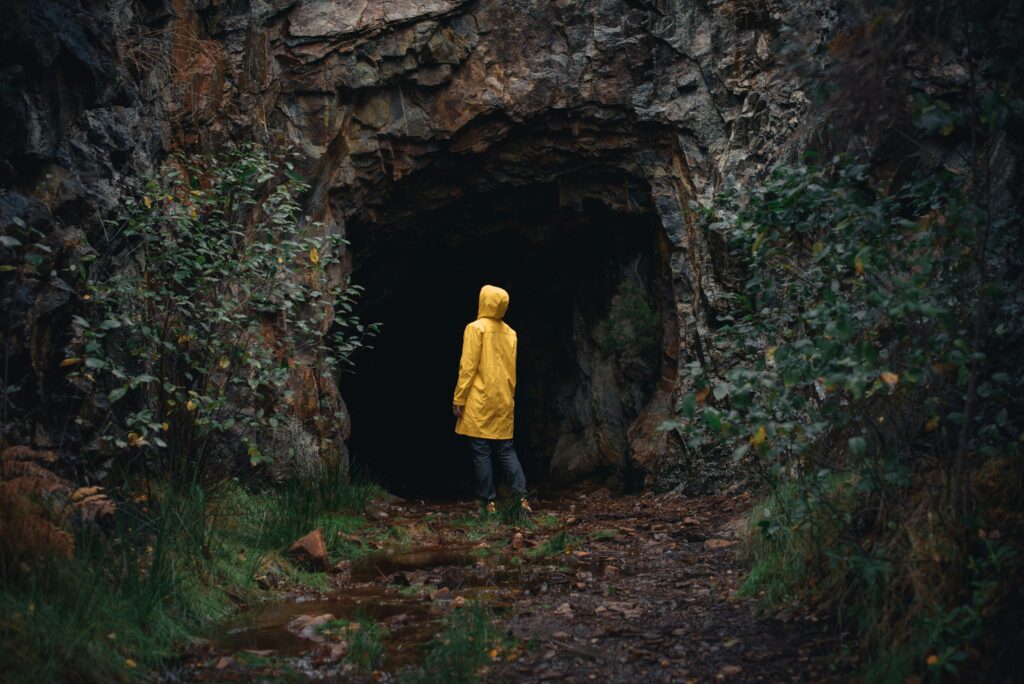
Fear is not typically a desirable emotion to talk about. We glorify fearlessness and try to downplay fearful situations. We try to minimize or eliminate sources of fear in our life, generally speaking. Consider the famous quote by President Roosevelt, “The only thing we have to fear is fear itself.” Young boys are often taught to posture as if they’re not afraid. This is shifting in our generation, both for better and for worse. Often when kids are afraid, they are met with, “oh there’s nothing to be afraid of, stop being afraid.”
Fear in the family
Then we come to our own families. Consider how our parents were formed by their parents’ experiences of fear. Were they survivors of war as veterans or refugees? Were they immigrants coming to a foreign-to-them land, perhaps with no possessions, community, or even grasp of the language? Go back two generations and you will likely have someone in your family who was deeply shaped by fearful experiences. Or perhaps, you need to look no further than your own upbringing for fearful, traumatic experiences. It is so rare for me to hear people say, quite simply and unapologetically, “I’m afraid” or “I’m scared.” Our parents and our mentors often don’t have useful language or ideas about working with fear. All of the above is just as relevant for them, too. We are all in this together.
Parenting and fear
I’m guilty of this often as a dad unless I pay closer attention to myself and my kids. I’m a recovering fear-denier. In moments like this, the sensory signals we identify with the emotion of fear get discredited. We begin to disconnect our sense of fear with our ability to identify it. We also learn that bringing fear to someone else is generally unhelpful and not met with deeper connection.
What would I rather say to my kids on the days where I’m alert? “Hey, I can see that you’re feeling afraid. Your body is showing me that, can you feel it too? Is there something you would like me to support you with? You’re safe with me. You can stay here until the feeling passes or we can do something to meet it.” For some of you, this language might sound weird and clunky. Working with fear is much more rich than simply noticing we are afraid, you’ll discover. Bear with me, and let’s go further up, and further in to this exploration.
Fear is functional
All emotions are meant to move us, to give us energy, an impulse, and maybe even an idea. Emotions help us to meet reality often faster than we can consciously understand and problem solve with. They modify our heart rate, our skin response, and our muscle tension. Our breathing rate is impacted. The convergence/divergence of our eyes subtly impacts our field of view; our sensitivity to hearing is also altered. Our throat and digestive system’s movements are changed, which is an automatic process we cannot ever consciously directly control. Emotions do things to us so that we can do something.
That’s a good working definition of functional. We can function in a new way, or we can do a new function. Fear, no less or more than any other emotion, is an opportunity to be functional. It’s not good or bad. It’s not right or wrong. Rather it’s a question of: can I do something useful with this energy, impulse, and thought? Working with fear can help us focus. It can give us the level of energy we need to stay engaged, to troubleshoot and get creative. That is, if we are able to work with it. Fear that cannot be contained in our system can quickly transform into terror, and we’ll discuss that later.
Fear is a signal
On it’s own terms, fear helps us locate danger and the path through/away from danger. Fear is a signal that some part of our system has perceived a threat. This can be a threat to us or who/what is important for us and our survival as we know it. We ignore/suppress our fear at great cost, and can make ourselves vulnerable to all kinds of risks if we do not take our fear seriously. It can freeze us, or put us into fight/flight. This happens even when we don’t pay attention to fear and usefully redirect it by choice. We need our fear, and to make space for it in our lives. We’re at our best when we’re working with our fear rather than against it.
Fear and Terror
Through my training in the Bodynamic system, I’ve been given a helpful distinction between emotions and instincts. Emotions are the embodied experiences that move us. Our instincts take over where emotions can no longer be contained by our bodies. The experience becomes too charged, too activated to stay in control of it with our choosing mind. We feel our need to move too urgent to thoughtfully think through. Instincts move us far more powerfully than emotions can. Of the seven emotions we work with in Bodynamic, each has a corresponding instinctual aspect. Consider the Window of Tolerance model. Emotions are what’s within the window of tolerance. Instincts are what take us over (kicking out most of our conscious/rational/choosing part of our brain) when we’re overwhelmed. Joy turns to ecstasy, anger to rage, fear to terror.
The level of activation in our system between an emotion and an instinct is extraordinarily different. Emotion is as loud as a casually spoken word, instinct is as yelling through a megaphone. Fear that is not contained becomes terror. Terror takes us over and moves us with extreme potency when danger is identified. Or if danger cannot be identified and run from or fought, we stay frozen in terror. When we become afraid of our fear, we lose capacity to stay in connection with others and ourselves. This can send us into our instincts.
Fear sabotages our goals
This dynamic can happen in a fraction of a moment. It’s not always movie-level dramatic. We have strong and varied coping strategies that help us defend against experiences we do not think we can contain. We learn these at each developmental stage of growth in our life. They’re usually automatic, and often take care of us before our experiences rise into our awareness. Different themes evoke fear in us in different ways. We can develop strategies of avoidance that look like ADHD, even if they’re not diagnosable as ADHD. It can look like rigid beliefs/statements about thoughts we won’t entertain or places we won’t go. It can look like blanking out or dissociating. We have trained ourselves in many different ways to be working with fear. Quite possibly, most of these ways come to us as naturally as breathing. And we don’t think about breathing most of the time.
Holding fear differently
Not all of us tolerate the same amount of fear, nor do we tolerate fear the same way. And that’s ok. Where we are in life usually works “well enough” for us, most of the time. We can “choose to settle” even, and that can be ok too when we’ve distinctly chosen that part of life. There’s a cost to every choice, whether it is to change or to stay the same. But sometimes we square off with the decisions we’ve made, we look at them and say to ourselves, “the pain of staying the same is worse than the pain of changing.” This is a magical moment. Therapy helps here, both in helping us get to that point and then do something with it.
Fear at the limits
But we don’t always change. I’ve worked with hundreds of people. Many of them change, and many of them don’t. Fear rising to a point where it is no longer tolerable in the body is one key reason. So they can rally all the reason’s they should change, they can be in immense pain and suffering, they can make a few weeks of progress, and then the system rolls back and they’re right back where they were. Sometimes this has to do with core decisions we make in trauma, and sometimes it’s simpler with building fear tolerance. The second is always part of the first, but the first is not always part of the second. Fear bubbles up, we hit our limit, and the override takes us back to “the comfort of the familiar,” as painful as it may be.
Working with fear looks like courage
In English, we’ve collectively inherited a wonderful word: courage. Courage is our ability to move with intention while experiencing fear. Courage is not the absence of fear. It is action plus fear. We can, in fact, accomplish much while experiencing fear in our bodies. Fear, even, becomes an indication that something is quite meaningful to us. This is a signal. Fear focuses us, forces us to cut the crap, to hone in, and to prepare. Here, fear becomes something like a super-power. A colleague of mine loves kite-boarding, and because we share the same training, he shared something that was fascinating. To paraphrase:
“When I’m out in the water and the wind, and I harness both to jump twenty feet into the air and look down, I feel fear. It rises in my chest and I feel it in my eyes. And when I notice that fear, it threatens to take me over and throw me off. This is really dangerous, because if I land wrong I could seriously hurt myself.
So I take that fear that rises in a particular part of me, and I try to send it to every other part of my body, to feel it in my fingers and toes and nose as well as my lungs and throat. Instead of being one or two very intense points, my entire body is energized and focused and I feel so much more alive.”
The psychiatrist Fritz Perls, founder of Gestalt Psychotherapy, is known for the saying “fear is excitement without breath.” The physiology of the two have much in common. Breathing is primarily an automatic process. It is one of the only automatic processes in our body that we have the ability to consciously take over.
We can make space for fear, leverage it, and breathe through it. This is our blueprint on how to prepare ourselves to be more courageous. With sober, focused courage, we can make changes that move us closer to the things we find great meaning in. Dare to take your fear seriously, to leverage it, and take courage.